
The Rise of Non-Engineers in Top B-Schools — What’s Driving the Shift?
For many years, India’s top management colleges were mostly filled with engineering students. From IIM Ahmedabad to IIM Bangalore, the stereotype held that most students entering flagship MBA programs came with technical backgrounds. Yet, in recent years, a quiet transformation has been underway across IIMs, XLRI, SPJIMR, and other elite institutes. More students from arts, commerce, humanities, and non-technical disciplines are gaining entry into these programs. They aren’t merely participating — they’re thriving. This trend signals a larger evolution in how tier 1 business schools in India view potential entrants, how good business schools in India balance their cohorts, and how aspirants shape their CAT exam strategy to broaden their opportunities. Diversity, once an afterthought, is now a central tenet in B-school admissions, curricula, and classroom experience.
Changing the Composition: The Numbers Speak
To understand how far the change has come, let's look at some of the recent data. A few years ago, engineering graduates made up 80–90 % of the student population in leading IIMs. Today, that ratio is noticeably shifting.
- IIM Ahmedabad’s PGP 2024 cohort reported over 30 % non-engineers, marking one of the highest proportions in years.
- IIM Bangalore and IIM Calcutta have similarly seen gradual increases in students with backgrounds in commerce, economics, or humanities.
- Other notable good business schools in India—such as SPJIMR, MICA, TISS, and IIM Indore—have actively emphasized diversity in their selection processes, welcoming students beyond the engineering discipline.
- What does this transformation mean? It implies that tier 1 business schools in India are no longer restricted to engineering. Instead, they are evolving into management ecosystems valuing varied academic foundations, fresh perspectives, and balanced cohorts.
Why B-Schools Are Embracing Non-Engineers
- 1. Richer Class Discussions Through Diversity
- Case discussions, role plays, and management simulations are at the core of B-school pedagogy. In a B-school classroom, debating a marketing case or an HR dilemma demands more than pure technical reasoning. When students from arts, commerce, or humanities backgrounds chip in, they bring:
- Creativity and narrative insight
- Empathy toward people-centric challenges
- Context from economics, psychology, or sociology
- By incorporating these perspectives, discussions become richer, more multidimensional, and more closely aligned with real business environments. That’s one reason good business schools in India value diversity so heavily in cohort composition.
-
2. Demand from Industry for Balanced Skillsets
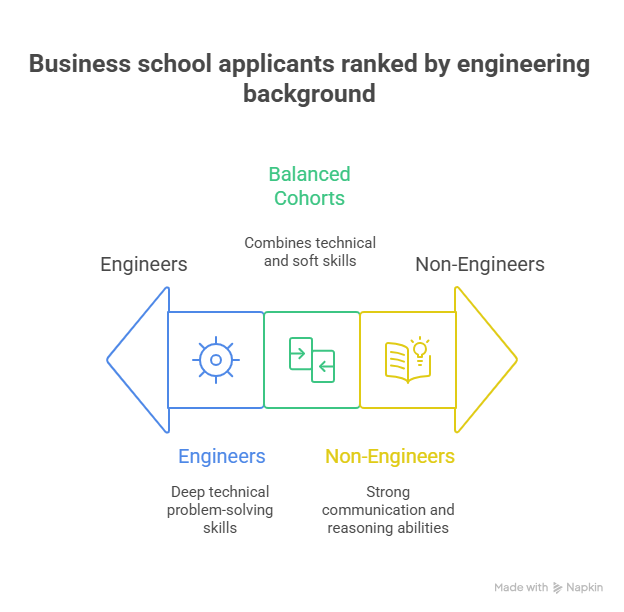
- Modern organizations no longer look for one-dimensional executives. Recruiters now prefer candidates who can combine analytical skills with human understanding, storytelling, and empathy. That’s where non-engineers have competitive edges: Stronger communication and narrative skillMore comfort with qualitative reasoningAn ability to translate domain knowledge from non-technical fields into business insightsAs firms increasingly hire from tier 1 business schools in India, their hiring criteria evolve concurrently. They expect graduates to be well rounded, not merely technically adept.
- 3. Reforms in CAT & Selection Policies
- To accommodate this shift, many institutes have introduced structural changes in their admissions. Key policy adjustments include:
- Academic diversity points or bonus scores for non-engineers
- Sectional cutoffs in the CAT exam to prevent over-reliance on one subject
- Weighting verbal ability, reading comprehension, and logical reasoning more seriously
- Holistic evaluation through interviews and profile assessmentsThese changes incentivize candidates from non-technical backgrounds to adopt a different cat exam strategy, one that balances quantitative rigor with verbal and logical strength.
Crafting a Cat Exam Strategy as a Non-Engineer
- Joining a tier 1 business school in India from a non-technical background is eminently feasible — if your cat exam strategy is well thought out. Below are actionable approaches tailored for non-engineers.
A. Build Quantitative Aptitude Gradually
Numerical ability is unavoidable in CAT and other competitive tests that top good business schools in India use.
To master it:
Begin with fundamental topics: arithmetic, percentages, ratios, speed & distance, algebra, geometry.- Use real-life examples (finance, commerce, statistics) to make abstract concepts tangible.
- Gradually increase difficulty — consistency over intensity.
- Set small weekly goals: e.g., “this week I’ll master ratios and percentages.
A well-balanced cat exam strategy ensures that quantitative weaknesses don’t derail your overall performance.
B. Practice Logical Reasoning & Data Interpretation
Non-engineers can often excel at reasoning and data work if they adopt regular habits:
Use puzzles, brainteasers, and timed sets to build pattern recognition
Train on data interpretation (DI) from business case data, charts, tables
Work on mixed sets that combine logical + data problems
- Because diversity in backgrounds often means different cognitive strengths, non-engineers can leverage this to outperform in reasoning + DI sections of the exam.
C. Lean into Verbal & Reading Strengths
One of the key advantages many non-engineers already hold is a stronger command over language and reading comprehension: - Read newspapers, opinion columns, long-form essays, literature
- Practice critical analysis and inference
- Expand vocabulary — but in context (learn usage, not just definitions)
- Solve verbal ability + reading comprehension (VARC) mocks daily
- Your cat exam strategy should treat VARC not as a weakness, but as a pillar to build strength upon.
D. Use Mock Tests as a Mirror
Mock tests are not about scoring high instantly; they are diagnostic tools:
- Take section-wise mocks early to identify weak spots
- Track performance trends and improvement over time
- Focus more on error analysis than on total score
- Adjust your daily plan based on mock outcomes
Many aspirants ignore mock review; your cat exam strategy must make mock analysis a daily discipline.
E. Time Management & Sectional Balance
In CAT, each section has fixed time bounds. Your cat exam strategy must weave in:
Strict time allocation per section/sub-section
Safe-to-risk transitions (if stuck, move on)Buffer time for revisiting tricky questionsBalanced attempts so no one section sinks your overall scoreA candidate with strong verbal skills but weak quant must manage time so as not to lose too many marks in the weaker section.
From “Non-Engineer” to Strength — Positioning Your Unique Story
Transitioning from a non-technical background is not a liability — it can become your unique selling proposition (USP) if you position it well.
1. Tell a Story of Adaptability
Use your personal journey to show that you can traverse from non-technical learning to analytical domains. Highlight: Curiosity to learn new conceptsExamples where you adopted quantitative tools in past work or academicsInitiative you took to build new skillsThis narrative complements your exam score and admissions profile.
2. Emphasize People & Communication Skills
Your natural strength might lie in human insight, communication, persuasion, and leadership. Demonstrate: Experience in mentoring, volunteering, or teamworkLeadership or people-centric rolesYour comfort handling ambiguity, empathy, stakeholder communicationThese traits align with what B-school admissions committees — especially at good business schools in India — look for beyond pure scores.
3. Leverage Domain Knowledge from Non-Technical Fields
If your background is commerce, arts, psychology, social sciences, etc.: For commerce: highlight grasp of business fundamentals, accounting, financeFor social sciences: show understanding of consumer behavior, societal trendsFor humanities: underline critical thinking, writing, ideationThis helps you stand out in interviews and essays — you bring a lens that engineering-trained peers may lack.
4. Articulate “Why MBA” Sharply
Your motivation matters more than your background. Use your narrative to:
- Explain why an MBA is essential to your goals
- Show clarity in how you will combine your past domain with management
- Project a vision of how you’ll contribute to your batch’s diversity
Admissions panels often say: they don’t bet on your past, they bet on your future.
How This Shift Benefits Tier 1 Business Schools in India & Students
For B-schools
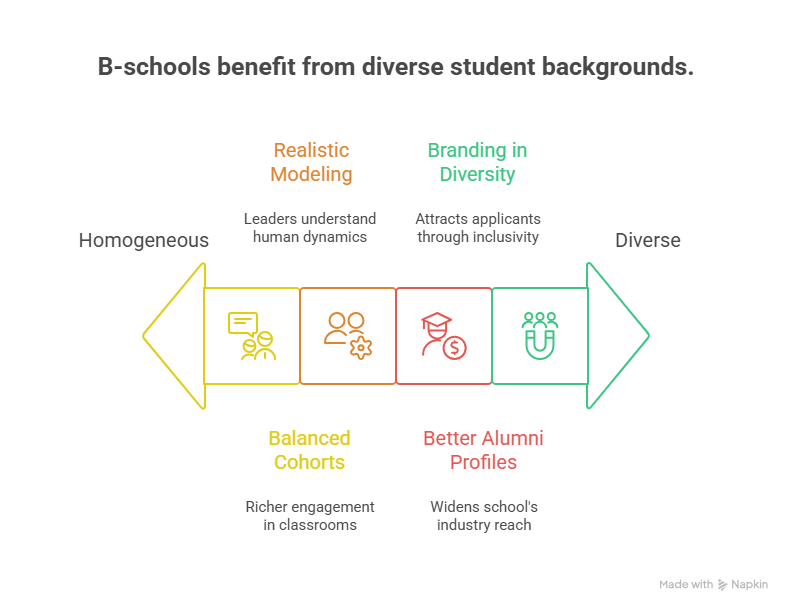
- Balanced Cohorts: Classrooms where 30–40 % students come from non-engineering backgrounds tend to engage more richly.
- Realistic Management Modeling: Many organizations need leaders who understand human dynamics; diversity fosters that mindset.
- Better Alumni Profiles: Graduates with varied backgrounds widen the school’s industry reach.
- Branding in Diversity: In a competitive environment, good business schools in India attract applicants by championing diversity and inclusive admission.
For Students (Non-Engineers)
- More viable pathways to tier 1 business schools in India
- Equal opportunity to compete — exam reforms favor balanced cohorts.
- A chance to bring fresh lenses to business problems.
- Ability to tap strengths in communication, reasoning, narrative, domain-specific insight
Structuring Your 1-Year Plan (Sample) with a Cat Exam Strategy
Below is a sample roadmap for a non-engineer aspirant targeting good business schools in India:
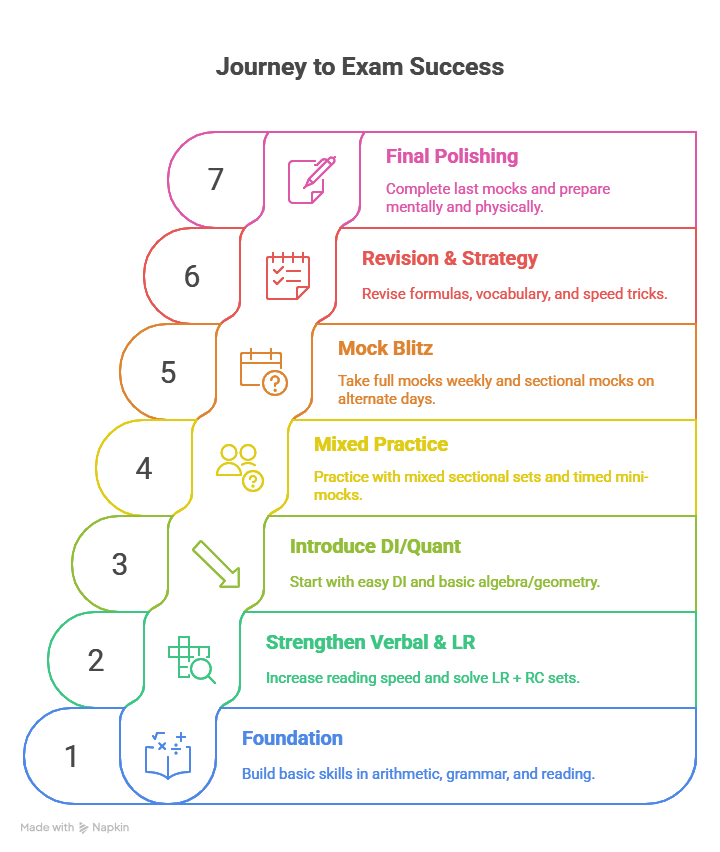 Throughout, your cat exam strategy must combine consistency, review, adaptation, and mental resilience.
Common Pitfalls & How to Avoid Them
1. Overemphasizing quant too early
Many non-engineers feel compelled to devote all time to quant. Balanced focus is safer.
2. Ignoring weak verbal reading habits
Because VARC is a scoring section, neglecting reading is a misstep.
3. Not analyzing mocks deeply
If you just take mocks and don’t dissect them, your cat exam strategy lacks feedback loops.
4. Lack of consistency
Sporadic bursts of study won’t help. Consistency, even with fewer hours, often beats intensity.
5. Weak storytelling in application
Test scores matter, but your narrative about why you, as a non-engineer, belong in a tier 1 business school in India is pivotal.
Final Thoughts
The landscape of good business schools in India is undergoing a meaningful redefinition. Being a non-engineer is no longer a barrier — it can be an asset if you deploy the right cat exam strategy, tell your story compellingly, and lean into your strengths.
As tier 1 business schools in India continue to emphasize diversity, the CAT exam and selection criteria will likely keep evolving. This opens up an unprecedented window of opportunity. Anyone, regardless of academic origin — arts, commerce, economics, humanities — can aim for the top.
Your success will depend on how well you adapt, how regularly you practice, and how clearly you narrate why MBA in your voice. Embrace the advantage that your non-engineering path gives you: real-world insight, communication strengths, and a fresh perspective. Combine that with a disciplined cat exam strategy and the will to grow — and you’ll find that the journey to a B-school like IIM Ahmedabad, IIM Bangalore, or any tier 1 business school in India is not just possible, but within your reach.
FAQs
1. I'm from a commerce and arts background; can I really compete with engineers in CAT Quant?
Yes, with consistent practice and a solid understanding of basic concepts, non-engineers can perform just as well in CAT Quant.
2. What should non-engineers focus on most while preparing for CAT?
They should focus on building a strong foundation in quantitative skills, improving accuracy, and managing their time effectively during practice.
3. How can I highlight my non-engineering background as a strength in interviews?
Emphasize your diverse perspective, strong communication skills, and ability to apply real-world insights in analysis.
4. Do I need to take extra math or reasoning classes to catch up?
Only if you find the basics hard to understand; otherwise, targeted self-study with good resources is enough.
5. What are some success stories of non-engineers making it to top B-schools?
Many commerce and arts graduates have successfully passed the CAT and joined top IIMs by making the most of their unique backgrounds and disciplined preparation.